

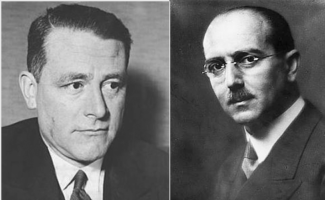
Defending Democracy: Kelsen vs. Schmitt
In his analysis of Carl Schmitt’s attack on democracy, Christopher Adair-Toteff argues for the contemporary relevance of Hans Kelsen’s robust defense of liberal democracy.
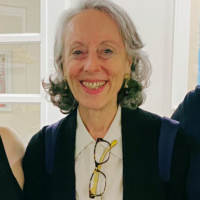
In Memoriam: Robin Wagner-Pacifici
In remembering his dear friend and colleague, Jeffrey Goldfarb highlights the importance of Robin Wagner-Pacifici’s writing on social conflict, collective memory, and social events.

‘To compose a sentence was to take a moral stance’
As a writer, Slavenka Drakulić sought to evoke the life of the single individual in a way that made empathy possible, writes her friend Marci Shore.
Can Democracy Think Beyond the West? Islam, Orientalism, and the Limits of Reaction
Eyyup Yilmaz, (Loyola University) discusses the nature of debates surrounding Islam and democracy. Starting from a lecture by Ernst Renan, he shows how both Muslim and non-Muslim actors fall into a modernist trap of thought when discussing Islam and democracy.

Still Groundhog Day in Albania; Or: Albania’s Orbán Moment
Robert Austin (University of Toronto) argues that while for some the promise of a $4 billion dollar resort linked to Jared Kushner and Ivanka Trump is a sign Albania has finally made it, for others, it caps 35 years of shabby democracy and rampant development devoid of vision or rules.
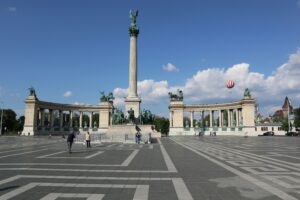
Electoral Revolution: The Collapse of Hungary’s Electoral Autocracy
András Bozóki (Central European University), Andrea Szabó and Zoltán Gábor Szűcs-Zágoni (Eötvös Loránd University) examine TISZA’s electoral strategy and its implications for challenging electoral autocracy without violence.

A War of Interregnum
Hussein Banai (Indiana University) argues that what is underway in Washington is a revolution from within. Previous American wars, however disastrous, were waged by a state with recognizable continuity; this one is being waged by an extractive regime that is turning the state into a pariah.
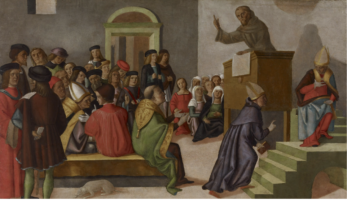
A Reliable Ally? Catholicism and Democracy Under Pope Leo XIV
Patrick Gilger (Loyola University Chicago) describes how Democracy Seminar seeks to understand and help build communities that are united not by pre-existing commonalities but by a commitment to a common search for the common good.

Relaunching the Democracy Seminar
Michael Weinman (Indiana University Bloomington) and Siobhan Kattago (University of Tartu) discuss the relaunch of Democracy Seminar 3.0 and the founding of the European Democracy Institute as a space for critical reflection, debate, and transatlantic collaboration. Drawing on the intellectual legacies of Hannah Arendt and Fritz Stern, they examine contemporary authoritarianism, democratic backsliding, and the enduring relevance of thinking critically in times of crisis. Against the backdrop of shifting global power, it frames the renewed Democracy Seminar as a “third escape toward freedom”—an effort to sustain democratic imagination, accountability, and shared political responsibility.

The Democracy Seminar and Me
Reflecting on the history of the Democracy Seminar, Jeffrey Goldfarb (The New School) traces its evolution from a semi-clandestine transnational network during the Cold War to its present role within the European Democracy Institute and the New School. The essay explores how decades of dialogue, disagreement, and collaboration shaped both the Seminar’s democratic commitments and Jeffrey Goldfarb’s own intellectual work, reaffirming the importance of critical public thought in times of democratic crisis.