
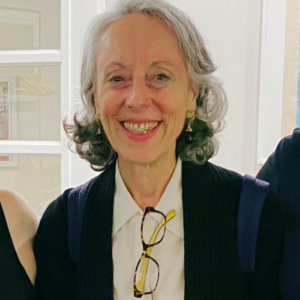
On July 5 th, I learned of the sudden and untimely death of Robin Wagner-Pacifici in a note from her New School email address. Her daughter, Laura, sent me devastating news: an aggressive cancer took Robin’s life suddenly the day before. “We will miss her terribly. You meant an enormous amount to her and we know she valued your years of friendship.”
Indeed, we valued each other’s friendship for many years. Our last correspondence was on June 13 th. In a text message, I proposed talking to her on the 15th to catch up. She responded with unexpected horrible news. She told me that she was quite ill, “something similar to you” [I live with a controlled multiple myeloma]. “Sorry not to have let you know sooner but it has come on suddenly. Thanks as always for your friendship and support.”
In this way, a four decades long friendship came to an end. It started when she wrote to me about my dissertation while she was still a graduate student and I was just starting my teaching at The New School. It intensified when I heard her give a talk at the American Sociological Association about the Vietnam Veterans Memorial. I approached her to talk about it and we kept on talking ever since. Later, she invited me to be an outside examiner for final projects at Swarthmore, and then after exploring the possibility of her coming to The New School for many years, inviting her to give lectures, I persuaded her to come to The New School to be my colleague in our sociology department. Along the way, Robin taught me many invaluable lessons.
Reading her publications and discussing them with her, I came to a deep understanding of the Aldo Morro affair in Italy and the Move movement in Philadelphia, the stand-off in Waco, Texas, and of stand-offs in general, surrender between sovereign powers, the restlessness of events, and the texture of collective memory, and much more. She studied disrupted moments in social life and how people constituted and navigated through them, through discourse about them. I was astounded how she accomplished this by analyzing texts, records of the spoken and the written word, without conducting an interview or embarking upon ethnography. How far and deep she could go was magical. This magic is on brilliant display in her last book, Scenes and Their Senses: Close Reading as Theory and Method, in which she formulates her sociological perspective on the human condition by reflecting upon scenes, depicted events, from fragments of social scientific texts, works of fiction and poetry, film, theater and art. This posthumous text may be her most original. She allowed her creative imagination to run freely and the result is brilliant.
Working with Robin in the Sociology Department (we were office neighbors), I was in awe of her dedication to her students and the care she gave to her teaching, administrative responsibilities, and the mentoring of our junior colleagues.
Robin was much more “the professional” than I have been. While I explored an engaged public sociology, she was very active in the American Sociological Association and kept up with the literature in the discipline and related disciplines in her inventive, original way. She explored collaboration with quantitative sociologists. She was in dialogue with the main currents of sociology. At the same time, her work had obvious public political implications, which we often discussed. I did manage to convince her to write about these for my online magazine Deliberately Considered a few times. But generally, she was reluctant to write quick responses to the events of the day. She preferred the long view, with sustained attention given to the way people expressed themselves, examining their words in close and sustained discourse analysis.
She was a woman of distinction and elegance. Her writing was uniformly excellent, her sociological imagination was unsurpassed, her dressing and presentation of self, impeccable. I don’t think it’s possible to adequately understand social conflict, collective memory, and social events without drawing upon her insights. Her posthumous book, Scenes and their Senses, may very well be her most superb, underscoring how profound our intellectual loss is.
She was a brilliant, caring person. It always amazed me how carefully she read the work of students and colleagues, including mine. She was a great scholar and teacher. Robin also was a great friend. I will profoundly miss our conversations about politics, and social theory, and also our loved ones, and about the relative merits of my New York Mets and her Philadelphia Phillies.
***
Repost: From Facebook by Julia Sonnevend, Associate Professor of Sociology and Communications and Co-Director of the Center for the American Experience at The New School.
Remembering Robin Wagner-Pacifici
Some academics excel in scholarship, others in mentorship, still others in administration. Very few manage to do all three. Robin Wagner-Pacifici did. And most importantly, she was a genuinely curious, gentle, and earnest human being.
I will always remember meeting her for the first time during my hiring process. I was somewhat unsure whether to come to The New School. She spent hours talking me through the decision. At one point, as we were riding the New York subway together, she encouraged me to think beyond the department and imagine the many intellectual communities I might become part of throughout the university. She spoke about how she had found her “tribe”—her word—across the New School for Social Research, at Parsons, and beyond. She described the friendships and intellectual collaborations she had built across disciplines and encouraged me to do the same. Her confidence that an academic life is enriched by connections that transcend departments—and her warmth—helped me decide to come.
In the years that followed, we met regularly in cafés and, once, in her beautiful apartment. She mentored me through the tenure process, which she led with remarkable professionalism and care. She did the same for generations of students and junior colleagues.
I also remember how effortlessly stylish she always looked, as though she had stepped out of a fashion magazine photoshoot—which, let’s be honest, was hardly the norm or expectation at the New School for Social Research. And I fondly recall the Philadelphia Eagles sign on her office door. It reminded us that even sports were not beneath the dignity of a scholar of the sociology of culture.
One memory stands out in particular. At a college-wide faculty meeting, she spoke up against bullying behavior. She had clearly prepared herself for the moment, carefully gathering her resolve. Her voice trembled ever so slightly. It was a powerful act of individual courage.
As a scholar, I continue to build on her work on temporality, especially her book “What Is an Event?”and her essay “Theorizing the Restlessness of Events.” Robin taught us that events resist closure. They continue to unfold, accumulating new meanings as they travel through time, media, and people’s lives. I know that her work, her mentorship, and the communities she built will continue to be restless—in the very best sense of the word.
Our last meeting was in April. We picked up coffee and sat together in a park in Philly. She enthusiastically told me about the new book she was writing—the most personal she had ever undertaken. She spoke about it with the same curiosity and joy that she brought to everything else. She bought the coffee, and I told her I would get the next one.
There was no next one.
***
Repost from the New School for Social Research – Alex Aleinikoff, Executive Dean and University Professor
ROBIN WAGNER-PACIFICI, 1954-2026
To the NSSR community,
I am writing to share the sad news that Robin Wagner-Pacifici, University Professor Emerita of Sociology, passed away earlier this month.
A distinguished political sociologist and an expert in the relationship between language and violence, Robin came to The New School for Social Research in 2010. She had previously spent 27 years as a Sociology faculty member at Swarthmore College. Originally from Philadelphia, she received her BA in Comparative Literature from Brown University (1976), and her MA (1978) and PhD (1983) in Sociology from the University of Pennsylvania.
Robin’s research primarily analyzed society’s response to violent events, including those considered terrorist events. In particular, she focused on the language with which these events are described by the media, the government, and everyday people, and what that reveals about their changing conceptions of terrorism. Her many articles and books followed this topic around the world, from Europe in The Art of Surrender: Decomposing Sovereignty at Conflict’s End (2005) and The Moro Morality Play: Terrorism as Social Drama (1986), to the southern and western U.S. in Theorizing the Standoff: Contingency in Action (2000), to Philadelphia in Discourse and Destruction: The City of Philadelphia vs. MOVE (1994). Her most recent book, What Is An Event? (2017), an exploration of how events emerge and accumulate new meanings through time, received widespread praise and informed her 2020 NSSR talk on how to think about the COVID-19 pandemic as an event.
At The New School, colleagues remember Robin as a person of distinction and elegance, excelling equally in scholarship, mentorship, and leadership. Rachel Sherman recalls that Robin “was dedicated to her graduate and undergraduate students, the department, and the institution as a whole. Her intellectual curiosity and the breadth and creativity of her thinking was inspiring to students and faculty in the department, as well as to colleagues in Sociology and other disciplines around the world.” Jeff Goldfarb shares, “Her writing was uniformly excellent, her sociological imagination was unsurpassed. I don’t think it’s possible to adequately understand social conflict, collective memory, and social events without drawing upon her insights.”
Robin chaired Sociology from 2011-2014 and was appointed the University in Exile Professor in 2013. Reaching across schools and disciplines, she worked with Parsons faculty member Daniel Sauter to co-direct the Mellon-funded Integrative PhD program from 2017-2021, which taught doctoral students new analytical and expository techniques and fostered integrated research in design and the humanistic social sciences. She became a University Professor in 2020 and Professor Emerita in 2023.
Following her retirement, Robin returned to Philadelphia to lecture at the University of Pennsylvania and to follow new directions for her research. Her latest book, Scenes and Their Senses: Close Reading as Theory and Method, will be published by the University of Chicago Press in 2027.
We send our deepest condolences to Robin’s family, friends, colleagues, and students. We will miss her greatly.