

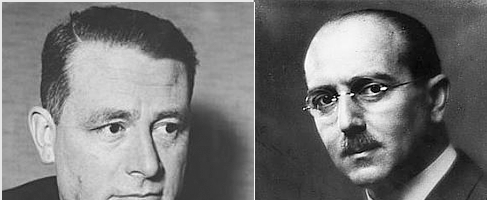
The ‘Guardian of the Constitution’ controversy is more than a debate about legal authority. It is a debate between democracy and autocracy in which Hans Kelsen defended democracy and Carl Schmitt promoted autocracy. Kelsen has often been referred to as the twentieth century’s “leading jurist,” while Schmitt has frequently been called the “crown jurist” of the Third Reich. Schmitt’s writings during the Nazi regime contain his fascist theories and his illiberal attacks on democracy. Hans Kelsen’s writings in defense of democracy are far-less well-known. His English language publications on democracy from the 1950s have attracted some attention, while his German writings from the 1920s have largely remained neglected due to the language barrier and their relative brevity. In contrast, Schmitt’s lengthy criticisms of Weimar’s democracy are well-known in the German original and in English translations. A comparison between the two legal theorists or antipodes on democracy is worthwhile because it illustrates arguments for and against democracy and those for and against autocracy.
Carl Schmitt’s arguments against democracy may be familiar but they can already be found in his writings prior to 1919. Even in his prewar publications, he argued for the need for security and order. This tendency was reinforced during the First World War and became pronounced during the 1920s and early 1930s. His books Politische Theologie (1922), Die Diktatur (1922), Der Begriff des Politischen (1928) are filled with his emphasis on the need for the sovereign, autocratic leader who makes decisions to safeguard his “Volk”, defend it from its internal and external enemies, and guarantees “public security and order” (“öffentliche Sicherheit und Ordnung”). Schmitt argued that Germany needed a single leader entrusted with total authority. Elected by all the “Volk”, the leader reflected the “will” of the “Volk.” Each of his decisions are assumed to be for the greater good of the “Volk” and are supported by it. Schmitt’s government is authoritarian and follows Stahl’s dictum “Autorität, nicht Majorität.” Moreover, Schmitt’s leadership is predicated on ideology and demands strict obedience. The leader has absolute power because he possesses absolute truth. There is no room for discussion because there is nothing to debate. In contrast, democracy is faulty because it encourages discussions which are long, involved, and ineffective. Democracy is an illusion because it does not reflect the authentic unified “will” of the “Volk”, but is the cacophony of a multitude of competing, ignorant voices. Schmitt’s preferred form of government is an autocratic one—the one that is the antithesis to democracy.
Hans Kelsen’s writings in defense of democracy are short and varied and have remained in the shadow of his Allgemeine Staatslehre (1925) and Reine Rechtslehre (1934). Kelsen’s only book devoted to the defense of democracy is his Vom Wesen und Wert der Demokratie (1929) but this rather short book is a revised and extended version of his essay of the same title, “Vom Wesen und Wert der Demokratie” (1922). Kelsen’s defense of democracy is also found in other, mostly neglected works: his lecture on “Demokratie” at the Fifth Conference of the Deutsche Gesellschaft für Soziologie (1926) and his “booklet” Staatsform und Weltanschauugen (1933). In each of these works, Kelsen defended democracy because it promoted the fundamental value of “freedom” (“Freiheit”). Kelsen noted that democracy also insisted on “equality” (“Gleichheit”) but argued that freedom was the higher value. “Freedom” was superior because it reflected self-determination and it rejected domination by someone else. Like Schmitt, Kelsen acknowledged that humans were social beings; therefore, there needs to be a state to ensure peace and to guarantee order. However, unlike Schmitt, Kelsen contended that the state should not be all powerful but should have the minimum ability to intrude. Rather than one, all powerful leader whose decisions cannot be questioned, a democracy thrives on lively participation and the exchange of opinions. Political parties are needed in a representative democracy, and they offer a plurality of opinions. Political representatives then participate in parliamentary debates. Through these lengthy discussions, a consensus is finally reached. The final decision may not satisfy all people, yet it is a compromise that is acceptable and effective. Kelsen’s parties and representatives represent a plurality and are not the unified “Volk” that Schmitt extols. Kelsen believed that Schmitt’s “Volk” was an illusion and that a single leader does not and cannot represent millions of citizens. Furthermore, there is no such thing as an absolute truth. That is a metaphysical and theological fiction; there are only relative truths.
This plurality of truths, political parties, and parliamentarian government requires patience and tolerance, not dictatorial commands and immediate obedience. For Kelsen, the essence and value of democracy is its political relativism, in contrast to the theological absolutism of autocracy. But Kelsen’s insistence that “value relativism” is not “value nihilism”—just because there is no single truth does not mean that there are no truths. This relativism of democracy embraces change in contrast to the statism of an autocracy. Democracy means that the majority rules, but that this does not imply that the majority is always right and will always dominate. Kelsen insists that in a democracy, the majority will not only tolerate the minorities, but will protect them because one day the ones in the minority will be in charge, and the former majority members will also want and need protection. In a democracy, dissenting may not be welcomed but is tolerated; in an autocracy, dissention is considered to be disagreement, which is tantamount to treason. In Staatsform und Weltanschauungen Kelsen argued that those who believe in democracy have a different “Weltanschauung” than those who have faith in autocracy. Those who defend democracy believe that freedom is the essence and the ultimate worth of humans, and that pluralism, tolerance, and its inclusiveness is to be fostered. In contrast, those adherents to autocracy were fearful of change, fearful of others, and were intolerant. The defenders of democracy were realists; they recognized human imperfections and accepted the “world as it is.” The autocrats were not realists; they wanted a new type of human being. They maintained they were not wishing for utopia, yet their insistence on creating the “world as it should be” was certainly utopian.
Hans Kelsen lost this intellectual and political battle and was forced to emigrate, first to Switzerland (1933) and then to the United States (1940). The Nazis consolidated their power early in 1933 and later in the decade they introduced new laws and issued decrees—which emphasized Schmitt’s autocratic ideas. Schmitt wrote several articles during 1934 and 1935 glorifying Hitler and in 1936 helped organize a conference which focused on the rejection of Jews in the practice of law and of Jewish ideas and ideals in the theories of politics. It is still not clear whether Schmitt recognized that he was providing some of the legal justifications for the persecutions of the Jews in the late 1930s. Nor do we know whether he could sense that his ideas would be used to defend the mass slaughter of the Jews and others during the Holocaust. What we do know is that Carl Schmitt continued to insist on order and to advocate for autocracy, both during the war and even more so later. We are becoming more aware that Hans Kelsen was not just the leading jurist of the twentieth century, but he was also one of that century’s greatest defenders of democracy and freedom. Kelsen died in 1973 but his early writings on democracy are clearly relevant today. With illiberalism again in the ascendancy, and with attacks on relativism central to that ascent, Kelsen’s advocacy for democracy provides intellectual and political ammunition for use in the contemporary battles against autocracy and for democracy.