

In October 2020, I attended a public consultation in Kohtla-Järve, a mining city in northeastern Estonia where residents had gathered beneath a white tent to discuss the potential demolition of their apartment buildings. Officials explained relocation options. People asked about repairs and furniture. One woman who had already moved reassured the others that she had taken everything, including her front door. Then a representative of the Ministry of Finance described the plan as being “in the interest of the state.” Before the explanation was finished, someone interrupted: “And why not in our interest?”
The question has stayed with me. It identifies a democratic difficulty that extends well beyond housing policy: the state can preserve its future while requiring its inhabitants to surrender parts of theirs. Sovereignty needs preparedness and institutions able to look beyond immediate interests. But it becomes questionable when officials assume that only they can speak for the whole. Public trust depends on institutions that give them reason to recognize the protected country as their own.
Around the Baltic Sea, this difficulty now takes on a sharper geopolitical meaning. Russia’s full-scale invasion of Ukraine has made the possibility of renewed imperial domination impossible to dismiss. For Estonia, Latvia and Lithuania, independence includes the ability to remain outside Moscow’s reach. Their preparations deserve to be understood through that history. An abstract opposition between freedom and security misses the fact that preparedness can be a condition of freedom. The harder question is how citizens retain authority over the terms on which they are protected.
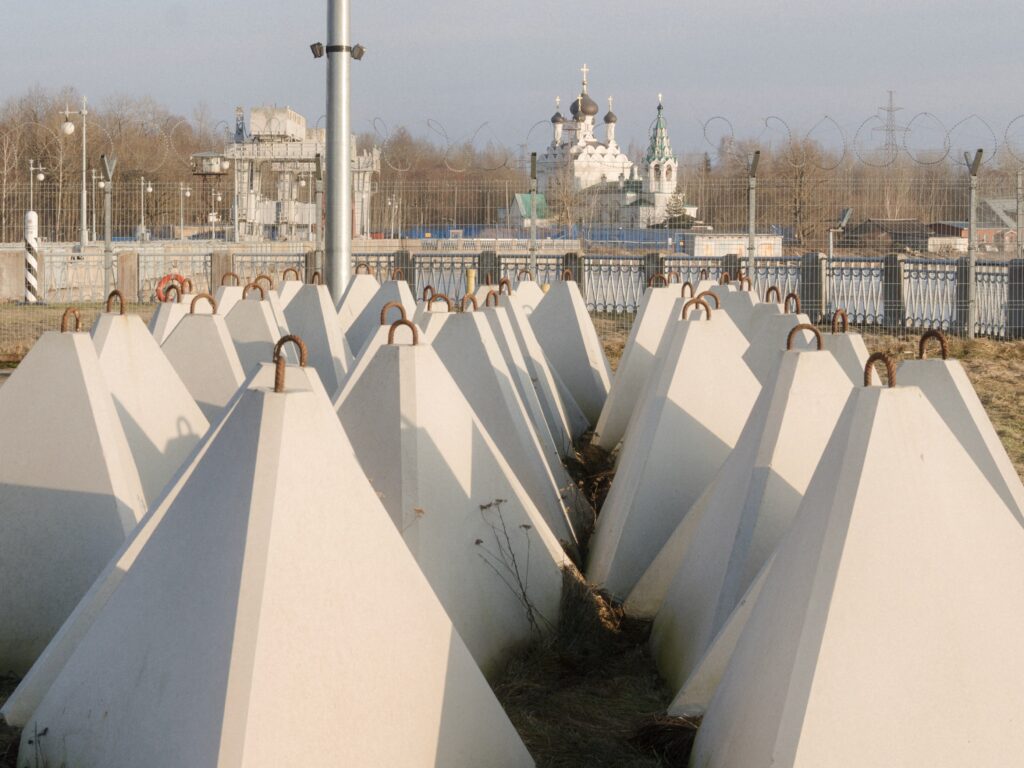
Electrical grids, railway corridors and airport protocols turn descriptions of possible danger into arrangements that people must inhabit. The redistribution of authority and obligation before a threatened disruption occurs represents a kind of anticipatory sovereignty. States have always prepared for danger. What matters here is how preparation acquires force through technical specifications and ordinary administration. Anticipatory sovereignty makes the continuity of the state into a public task. Yet the state is no longer the only actor entitled to take care of the security of its citizens. Sovereignty is extensively subcontracted. Insurers determine which infrastructures can be built. Private firms manufacture military drones and construct shelters. Technology companies own data centers and seabed cables.
Preparation creates another difficulty when its success takes the form of an absent event. At Vilnius Airport in December 2025, I waited with passengers whose flight had been postponed amid reports of incoming balloons. Sandra needed to make a subsequent journey to see her daughter in Hong Kong. She bought an alternative bus ticket to Riga while we searched for information. The aircraft eventually departed. No aviation accident occurred. During the interval, however, money had been spent and subsequent journeys were rearranged around the possibility of more interruptions.
The same applies when backup capacity prevents a damaged cable from interrupting service. In February 2025, Estonia, Latvia and Lithuania detached their electricity systems from the Russian and Belarusian frequency area and synchronized with continental Europe. The transition required years of engineering, investment and rehearsal. Its most convincing public result was remarkably undramatic: the lights stayed on. The Baltic states became more autonomous by coordinating more closely with one another and with their European partners. The political capacity is now the ability to choose and sustain dependencies. Rail Baltica exposes this problem at ground level. The project originally promised a standard-gauge connection between the Baltic states and the wider European railway network. It is now intended to enable military reinforcement.

Europe has long been built through infrastructure. Coal, steel, roads, customs regimes, energy and standards helped to produce political integration. The original wager was that interdependence could make war materially irrational. Today, it has changed. Infrastructures are still the form of European kinship, yet integration now includes selective disconnection such as the case of the BRELL energy system, cutting ties with unreliable neighbors while multiplying cable routes and inventing data embassies. A continent that once narrated itself through peace, enlargement and reconciliation now keeps its promises through batteries, alerts, and cables.
A democracy needs institutions and infrastructures capable of acting under uncertainty without granting their own suspicions permanent immunity from scrutiny. Urgent action and subsequent explanation belong to the same responsibility. For European democracies, this requires an account of how protective authority is accountable and can be corrected.
The dispute surrounding Pühtitsa, an Orthodox convent in eastern Estonia directly subordinate to the Moscow Patriarchate, makes the stakes especially personal. Estonian officials see that connection as a possible route of Moscow’s hostile influence. The nuns understand it as constitutive of their vocation. Both positions concern continuity, but they describe different things that must survive. Sincere devotion cannot settle a security assessment; suspicion cannot by itself settle the meaning of religious obedience. The burden of proof shifts towards demonstrating that a bond will never become dangerous. That demand can be impossible to satisfy.
Democratic judgment must distinguish religious affiliation from what can demonstrably be done through it. A democracy defending itself from imperial coercion has particular reason to preserve distinctions between influence, disagreement and disloyalty. Its own plurality is among the things at stake. Democratic preparedness must allow people to argue for an ordinary good life without first translating each need into a contribution to the country’s security. Ukraine makes the urgency of this argument painfully concrete. What remains an anticipated war for much of the Baltic region is destruction already endured by Ukrainians.
That demand brings us back to the tent in Kohtla-Järve. The resident’s interruption demanded a place within the state’s account of its interests. His question has acquired continental significance. Europe needs the capacity to build infrastructure, respond to threats and sustain difficult obligations. Its democratic future also depends on whether those obligations preserve a public able to challenge them.
The future, meanwhile, inherits more than our intentions. At Paldiski, a former Soviet nuclear submarine training site in Estonia, the withdrawal of military power left radioactive residues requiring containment and expertise. Radioactive waste, however, cannot be made harmless by a change of government. The restored Estonian state acquired responsibility for consequences it had not chosen.
Paldiski poses an uncomfortable question for present preparations too: which arrangements built to secure our future will become obligations that our successors can neither endorse nor abandon? And how much should a society change in order to prevent a crisis before it has transformed the life it intended to protect?
There is no easy answer in a region whose security fears are anchored in history and in the ongoing destruction of Ukraine. Yet that difficulty is the point. Security cannot be considered only by what it protects. It must also be assessed by the obligations it redistributes, the futures it foreclose, and the room it leaves for ordinary purposes that have nothing to do with survival.