


The recent elections in Hungary brought an end to the Viktor Orbán era and ushered in Péter Magyar as a pro-European head of government. These elections restored confidence among those who hope that the European Union’s development into a federal state will strengthen Europe’s international competitiveness and role in global politics, as well as reinforce democratic principles. As the other pieces in this Issue demonstrate, and as is clear from Jürgen Habermas’s (2012) “The Crisis of the European Union in the Light of a Constitutionalization of International Law,” the founding documents of the United States—especially the 1787 Constitution—are often cited as a model in this context.
Indeed, the parallels between the situation in North America at the end of the 18th century and the current effort to democratize the supranational level are illuminating. The Federalist papers, written by Alexander Hamilton, John Jay, and James Madison, challenged the widely held belief that democratic (or “republican,” as it was called at the time) conditions could only be realized in small, manageable areas. Madison famously wrote in Federalist No. 10 that the introduction of the representative system would guarantee republican principles, even in entities as large as the union of the 13 republics. Furthermore, the selection of representatives in large political units would ensure that demagogues would no longer determine the nation’s destiny, but rather, men “whose wisdom may best discern the true interest of their country.”
At the time, the Founding Fathers opposed the broader participation of ordinary men that had been partially implemented in some republics. Pennsylvania, in particular, had a highly democratic constitution even by today’s standards, with short terms of office, broad suffrage, and clear legislative supremacy. According to the Federalists, the issuing of paper money for debt reduction was a sign of anarchy and mob rule. Examining Madison’s correspondence from the late 1780s and his contributions to the Constitutional Convention reveal how closely Madison associated democratic practices with the introduction of paper money or debt reduction.
As Max Farrand (2007) reports in the Records of the Federal Convention of 1787, quoted here from vol. I, p. 48, and vol. II, p. 647, the primary concern of the political and economic elites who gathered in Philadelphia in early summer 1787 for the Constitutional Convention was therefore to curb this “excess of democracy,” as Elbridge Gerry of Massachusetts put it at the outset of the convention. Later on, Gerry referred to democracy as “the worst of all political evils.” This suggests that the new Constitution was intended, above all, to limit the common man’s influence on political affairs, especially economic and monetary policy, as Terry Bouton (2007) shows while narrating the economic conflicts driving debates during the convention and ratification period in Taming Democracy. Michael J. Klarman (2016) goes further to argue that the Constitution was “The Framers’ Coup,” underlining what he understands to be the fundamentally anti-democratic intentions of the Founding Fathers.
The Anti-Federalists opposed the draft Constitution. As Saul Cornell (1999) in The Other Founders and Jackson Turner Main in The Antifederalists document, they particularly resisted the transfer of sovereignty associated with the new Union and advocated for preserving the old federalist order established in the Articles of Confederation after independence was achieved. While the Articles of Confederation provided for close cooperation among the republics, they did not establish a separate basis of legitimacy for the federal level. As a result, the representatives in Congress were delegates accountable to their respective republics’ legislatures, a point emphasized by Pauline Maier (2010) in Ratification, a detailed discussion of the ratification debates.
One of the Anti-Federalists’ central arguments against the new 1787 Constitution was geographic expansion. They had in mind the differing economic structures and marked mentalities between the northern and southern republics. According to the Anti-Federalists, significant conflicts of interest and the absence of a common political culture spoke against closer union, drawing on arguments by Montesquieu and Rousseau. The Anti-Federalists feared, in particular, that a larger political sphere would significantly weaken democratic influence. The political elites would be more clearly distinct from the majority of citizens and less easily controlled. They argued that the result would be despotic conditions. Oddly, perhaps, the Anti-Federalists’ fears about the potentially despotic nature of the U.S. political system seem to be coming true at present.
The European Union is certainly not a despotic regime as the Anti-Federalists warned about the newly formed United States. However, as Michael A. Wilkinson (2021) argues in Authoritarian Liberalism and the Transformation of Modern Europe, over the past 15 years, the EU has evolved into a liberal-authoritarian regime. This paradoxical reality is characterized by the enforcement of liberal objectives against the will of the people because key policy areas have been removed from their sphere of influence. These areas, including competition law, international capital movements, and the so-called stability criteria, are already regulated by treaty law. Thus, these areas have essentially been granted constitutional status and are sacrosanct. Meanwhile, institutions with significant decision-making power, such as the European Court of Justice, the European Commission, and the European Central Bank, have been established and are largely beyond democratic influence. As the European level restricts the scope of action of member states and their democratically elected parliaments and governments, democratic decision-making power is lost. This loss is related to the size of the European Union.
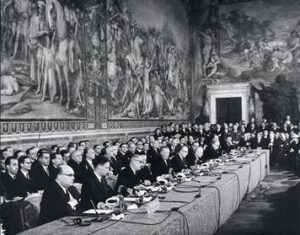
Six states signed the Treaty of Rome in 1957. Following seven rounds of enlargement, the number of member states has grown to 27, with preparations underway for a new round. The total population of the founding members in 1957 was approximately 168 million; today, the population of the entire European Union stands at approximately 450 million. Geographically, there has also been significant expansion, from 1.178 million to 4.104 million square kilometers. The number of official languages has also increased, from six to 24. These changes pose considerable challenges to the European Union, hindering its democratization and the development of a social union. How should this be understood?
Over the past 30 years, integration-friendly measures have relied on “primary law,” which has been increasingly interpreted in an expansive manner. This term refers to the substantive provisions enshrined in the European Union’s treaties, particularly in the areas of economic and monetary policy. A depoliticized mode of enforcement prevails here, particularly with regard to the fundamental freedoms of goods, services, capital, and people in Europe. The “negative integration” measures (Scharpf)—which primarily involve eliminating “distortions of competition”—have created an economic policy framework that leaves elected representatives at the national, regional, and local levels with little leeway to pursue an independent agenda. For example, they have little ability to subsidize domestic industries or give preferential treatment to local suppliers in public procurement. Lastly, it is worth highlighting the European Court of Justice’s integration-friendly case law, which has removed more and more policy areas from the purview of national legislation and administrative action.
On the other hand, a positive integration policy has developed only marginally due to the unanimity required in the European Council for such a policy. The heterogeneity of interests and political cultures hinders the development of a common policy, especially with regard to a uniform minimum wage or the establishment of a European welfare state. The same applies to a uniform, Europe-wide tax policy and an effective fight against tax loopholes. Even the European financial transaction tax, which leading politicians have called for since the financial crisis, has yet to materialize at the European level, as has the so-called digital tax. The high thresholds for consensus are to blame for this.
As Quinn Slobodian (2018) argues in Globalists, the disempowerment of national parliaments and governments was a central concern of neoliberal thinkers such as Ludwig von Mises, Friedrich August von Hayek, and James Buchanan. In an essay published in 1939 first titled “The Economic Prerequisites of Federal Arrangements“, Hayek advocated for the creation of a supranational space for economic activity with only a weak executive branch: “This means that the federation will have to possess the negative power of preventing individual states from interfering with economic activity in certain ways, although it may not have the positive power of acting in their stead.” He cites protective tariffs as the prime example of undesirable state interference in the economy. Later in the same piece, however, , Hayek mentions restrictions on working hours, statutory unemployment insurance, and even restrictions on child labor, which would be more difficult to implement under a supranational federalism.
Hayek’s argument is not new. As seen above, James Madison recognized this in Federalist No. 10, stating that the new Union’s essential advantage lay in its size and heterogeneity, which prevented the “excesses of democracy.” Like Hayek, Madison primarily—though not exclusively—viewed this as interference with the economic interests of the wealthy. This could take the form of a democratically approved debt moratorium or the issuance of paper money. As he writes with unvarnished candour at the end of the tenth article, it is precisely the size of the new Union that prevents such monstrosities: “A rage for paper money, for the abolition of debts, for an equal division of property, or for any other improper or wicked project, will be less likely to pervade the entire body of the Union than a particular member of it; in the same proportion as such a malady is more likely to taint a particular county or district than an entire state.”
So, what does this analysis of the relationship between size and democracy imply? It certainly does not mean that the level of supranational cooperation achieved should be entirely rejected. Nor does it suggest that close cooperation among European states is unfeasible. On the contrary, it is clear that challenges such as peacekeeping, climate change, and migration do not stop at national borders. Therefore, close cooperation, including within the framework of supranational institutions, is urgently needed. First, however, we should abandon the illusion that these institutions can be endowed with direct democratic legitimacy. Second, to revitalize democracy, it might be advisable to shift economic and fiscal policy powers back to nation-states. One model for this could be the U.S. Articles of Confederation. In this model, certain key areas are delegated to the supranational level, and the states commit to close cooperation in these areas. This can include qualified majority decisions, as well as directly enforceable rights for citizens of the individual states.
The key difference between the confederation model proposed here and the European Union, however, is that supranational regulation should not primarily take place in the areas of economic, monetary, and trade policy, as is currently the case. This does not rule out joint coordination in areas such as tax policy, nor does it preclude solidarity transfers; in fact, the latter are needed to an even greater extent than is currently the case. But the foundation for this can only be a strengthening of the decision-making power of national parliaments and governments.