A collaboration with The New School & the European Democracy Institute
Issue: Dispatches from Ukraine
Firsthand reports and reflections from wartime Ukraine documenting everyday life, resistance, displacement, and survival amid Russia’s invasion. Through personal testimonies and frontline correspondence, the series captures the human realities of war.
Category: Dispatches from Ukraine
Firsthand reports and reflections from wartime Ukraine documenting everyday life, resistance, displacement, and survival amid Russia’s invasion. Through personal testimonies and frontline correspondence, the series captures the human realities of war.
War seen in person looks less terrible than on television. However, when I notice that I am becoming less sensitive and danger stops arousing fear in me, I know that it is time to go home and decompress. MAREK KĘSKRAWIEC: In your texts about the war in Ukraine, you rarely share your own thoughts, you don’t make yourself the star, you give voice to the protagonists. This …
In Bakhmut, medics’ vehicles wait hidden under thick layers of earth and concrete. Artillery fire almost never ceases and every bit of the city is within its reach. They come by minibus. A piece of paper with the number “300” stuck to the window means that they are transporting the wounded. They stop. The two medics do not get out. Fear and confusion are painted on their …
After months of fighting for the city, the few inhabitants of Bakhmut are struggling to survive—without water, electricity or gas, and with winter temperatures. The street is dead. Its landscape is made up of concrete apartment blocks, rubble from hit buildings, broken glass and remnants of rockets. And the corpse of a dog covered with frozen snow, from under which you can see a dead eye, a …
Military medics rescue wounded soldiers at the front every day. The lives of the wounded depend on how quickly it is possible to provide first aid and transport them to a hospital in the rear. The light from the country house does not break through to the street, which is plunged into darkness of night. Tightly covered windows do not allow sight of what is inside the …
The writer, a supporter of Gandhi and his idea of “nonviolent resistance”, volunteered for the army in February 2022. This is one of many such checkpoints where you stop, show your documents, and then hope that you will pass quickly and without unnecessary formalities or problems. Holding such a rather thankless post is one of the tasks of Artyom Chapeye, a writer, translator, journalist, and, since the end …
MAJA HORELKINA, 39 years old, IT specialist, Przemyśl (Poland) If the war ended today, I would go to Kyiv. My family and friends are there. I would hug them all. I wouldn’t be afraid to let my daughter, Yevheniya, go there either, who, despite the war, has not given up her dream of opening a café in Kyiv. A backpack has been accompanying Maja since 2014. That’s when …
After six months of Russian occupation, the inhabitants of Izium regained their freedom. Two 74-year-olds, Lyubov and Lidia, look along the street. Lidia previously worked in a hospital. Her simple commanding posture, hands clasped behind her back, and calm and composed voice, reveal that Lyubov was a teacher. She had formerly taught Ukrainian in one of the local schools. The rays of the setting sun fall on …
Everyone would like to call and ask how their loved ones are doing. In vain, because usually after a few words the connection cuts out. The Central Square looks like a hurricane has come through. Some buildings have their roofs torn off, and the ground is covered with rubble. It’s a wonder that most of the lampposts have survived unscathed. On the building housing the city council, …
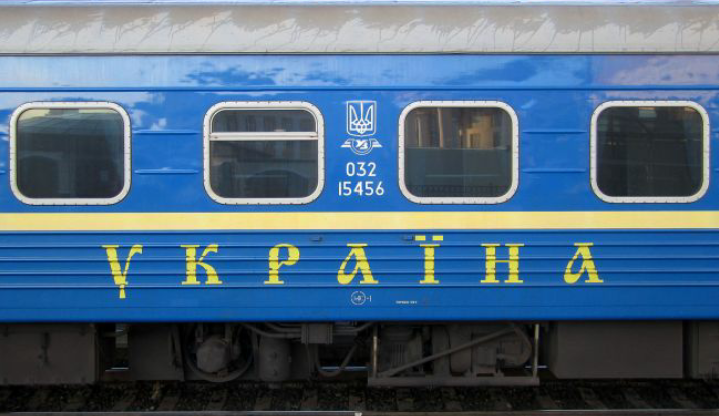
During the war, the Ukrainian railway has become one of the pillars on which the state rests. It evacuates civilians, transports weapons and brings hope. Only two letters remain from the inscription at the station: “BA”. Beside it there is a haunting hole, probably made by the shock wave. The platforms are empty. There are wagons, probably stuck here for a long time. At least for half …
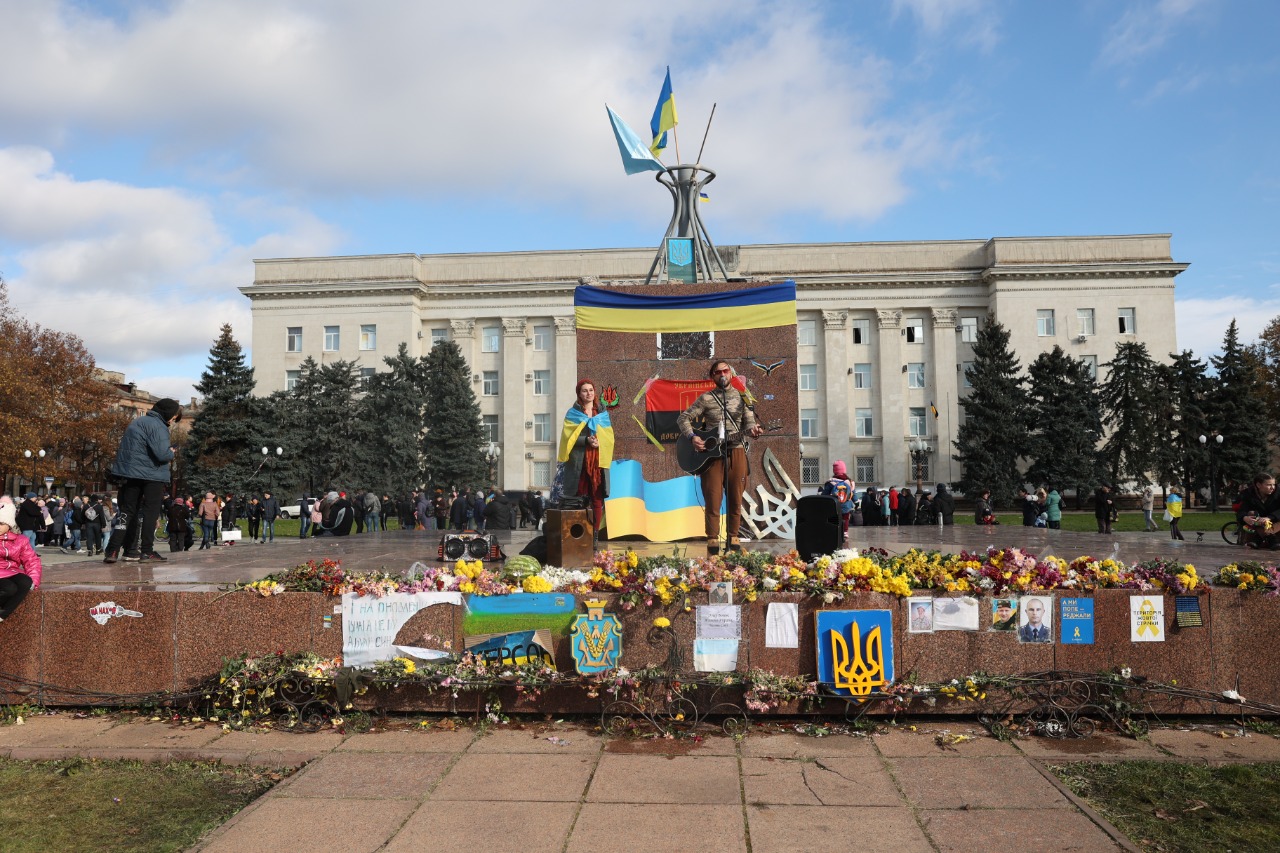
The inhabitants of Kherson greet the Ukrainian soldiers who have recaptured the city after more than eight months of Russian occupation. They also tell stories of Russian violence. Our correspondent, Paweł Pieniążek, is one of the first foreign journalists on the spot. Loud music, dancing, shouts of joy mixed with tears. People gathered in the central square of Kherson wave blue and yellow flags, drape themselves in …