

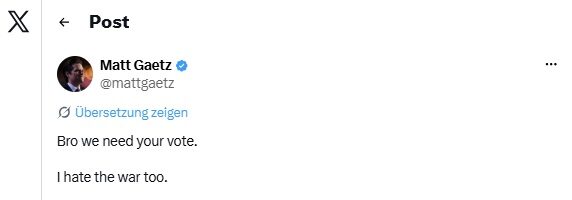
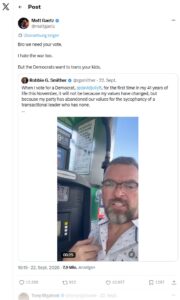
On September 22, 2026, former Congressman Matt Gaetz felt compelled to respond to a voter who posted a video on X saying he was considering voting Democratic because of his opposition to the war and the use of US military resources and personnel. Gaetz replied: “Bro we need your vote. I hate the war too. But the Democrats want to trans your kids.” When faced with worries about the war in Iran, Gaetz did not address the concern itself but introduced an alternative “risk”. After establishing affective alignment with the voter regarding the war, he invoked a perceived threat to “your kids”, a threat that appeared emotionally closer, and therefore potentially more immediate and deeply personal, than a distant war. The implicit argument being that if Republicans lose, Democrats will come after your kids to trans them, has become an increasingly prominent element of Republican electoral discourse over the past several years.
The political strategy of linking the protection of children to particular groups or issues that would otherwise be unrelated is not new. In 1977, Anita Bryant’s “Save Our Children” campaign drew on this explicit discourse of child protection to mobilise against gay rights in Dade County, Florida. Conservative evangelical activists portrayed homosexual teachers as morally corrupt, claiming that they sought to ‘recruit’ children (Frank, 2013). Almost four decades later, the Supreme Court’s decision recognising same-sex marriage in Obergefell v. Hodges marked a significant strategic shift as transgender rights increasingly became a site of conservative legal and political mobilisation (Eyer, 2024). Nagourney & Peters (2023) argue that this ruling was a setback for social conservatives, who subsequently began searching for a new issue around which to mobilise their supporters. Transgender identity gradually filled that space, and according to Nagourney & Peters (2023), the shift was not entirely spontaneous. By 2019, conservative organisations were testing which transgender-related messages resonated with voters. Polling by the American Principles Project found that voters were significantly more likely to support a Republican candidate favouring a ban on transgender girls in school sports when framed as whether to “allow men and boys to compete against women and girls” (Nagourney & Peters, 2023). Since his 2024 presidential campaign, Donald Trump has been one of the most prominent proponents of the broader anti-trans rhetoric (GLAAD, 2026). And as Republicans push their messaging ahead of the November midterm elections, FactCheck identified over $100 million in spending on more than 200 TV, streaming and digital ads since August 1, 2026 constructing that same threat. Across campaigns in Ohio, Texas and Alaska, Democratic candidates are portrayed as supporting “sex changes for minors” or “using taxpayer dollars for sex change surgeries on young children”.
Despite the prominence of these claims, research finds no recorded hormone prescriptions or gender-affirming surgeries among trans and gender-diverse minors aged 12 or younger, while gender-affirming surgeries, puberty blockers and hormones were rare among minors up to age 17 (Dai et al., 2024; Hughes et al., 2025). Against this background, how do children become politically useful? Which children are supposedly at risk, who is cast as a threat and who positions themselves as the protector?
To understand the political power of this rhetoric, we need to examine how the figure of the child is constructed. First of all we can conclude with a high degree of certainty that the child is accepted as naturally cisgender and consequently outside of gender diversity. The ideal child therefore is presumed to be unaware of the plurality of gender identities and experiences, with this unawareness treated as a form of bliss that preserves the child’s innocence. In this rhetoric, innocence becomes more than a childhood attribute. It becomes a symbol of a moral order, national and at times racial purity that these political actors claim to defend (Stein, 2023). By contrast, diversity is something that is portrayed as being imposed by others upon the innocent child, leading to its potential corruption. Stein discusses how right-wing populist campaigns cast LGBTQ+ activists, feminists, teachers and medical professionals as agents of indoctrination. Framing gender diversity as something that can be ‘done’ to children implies that under no normal circumstances (and I use the word normal consciously and ironically here) would children feel the need to be or express an identity that falls outside the supposedly fixed binary.
This leads us to question if, under this framing, children are allowed to have agency and their own concerns and rights. Hence, do children know what is good for them and can they claim it? Is a trans child entitled to have needs and legal guarantees? If a non-dual gender identity is perceived as evidence of influence or recruitment, then any agency or articulation of these needs is itself taken to signal that these children have already been compromised by external forces (a dynamic Gash and Tichenor, 2022:95 describe as “exposure narratives”). Their representation as innocent is thereby destroyed. This imagined passivity comes to justify full control under the guise of protection. And exactly here emerges a powerful paradox. Only the ideal cisgender child becomes worthy of protection; the rest are denied it.
But who are the external forces portrayed as threatening children? For this, we will return to Gaetz’s X post that “the Democrats want to trans your kids” as one concrete example of enemy construction. Discursively, the threat is not abstract but attributed to actual agents and ideological opponents: the Democrats. Their agency is exaggerated through intention: want to. The Democratic Party does indeed explicitly support transgender rights and protections, as reflected in its 2024 platform. However here, Gaetz implies that this support is not the defence of rights but the pursuit of a particular outcome. The complex set of democratic policies is reduced to a presumed target: trans your kids. Turning an adjective/noun which is commonly used to describe transgender identity into a verb is the most interesting linguistic point. Gaetz constructs the verb ‘to trans’ as an external action imposed on someone. Although the wording differs, the ads mentioned before reproduce a similar ideological framing e.g. the Democratic candidate in Ohio “supports sex changes for minors.” The political opponent is presented as responsible for paving the way towards the alleged risk of gender diversity, whether through its promotion or its supposed imposition. In this narrative, feminists and LGBTQ+ people are accused of conspiring with medical professionals and teachers to undermine fixed notions of gender and sexuality (Stein, 2023). The consequences of associating minority groups with danger to children may extend beyond political debates, legitimising hostility against them. Once transgender people are constructed as a threat, their own rights and vulnerability are pushed out of view. Most strikingly, for transgender children, their transgender identity takes precedence over their status as children undermining their entitlement to protection. Gash and Tichenor (2022:84) explain how political narratives of “outsider” children “are meant to astonish or frighten people into action by asking audience members to set aside their beliefs in the innocence of children (at least in reference to these “outsider” children)”. In electoral campaigns, such representations and anxieties are used as a means of mobilising voters.
The rhetoric about shielding children from harmful external forces positions the Republican Party as the defender of family values and moral order, creating a powerful emotional electoral message. The emphasis is placed on purportedly necessary protective measures and away from the restrictions on transgender people’s rights. While children are not voters themselves, their vulnerability can become a vehicle for mobilising parents and other adult voters. However it is here where a tension between political/parental responsibility and a sense of ownership is created. Bluntly put, are my children my property? While they are obviously not literally our property, do we nevertheless establish a sense of ownership over them rhetorically? By claiming absolute authority to decide what the child is allowed to know, express or ultimately become, we risk treating children as objects of adult control rather than individuals entitled to self-determination. As a parent myself, I have often claimed to act in my child’s best interests by limiting his media consumption or voting for healthier school lunches against his will. But I strongly believe that guiding a child’s development is different than prescribing its outcome. On what grounds then can a political party assume that authority?
Should we allow politicians to instrumentalise children to advance their own agendas? Should we allow childhood to become a territory over which parties compete for the moral high ground? Governments, societies, and parents have a responsibility to establish safeguards and set necessary boundaries, but also to defend children’s voices and rights. Political parties should not claim to speak for children without listening to them. Nor should policies make child protection conditional on who they become or how they identify. We can speak of children’s innocence, their vulnerability and need for protection. But let us stop using them to fight ideological battles that are not theirs.